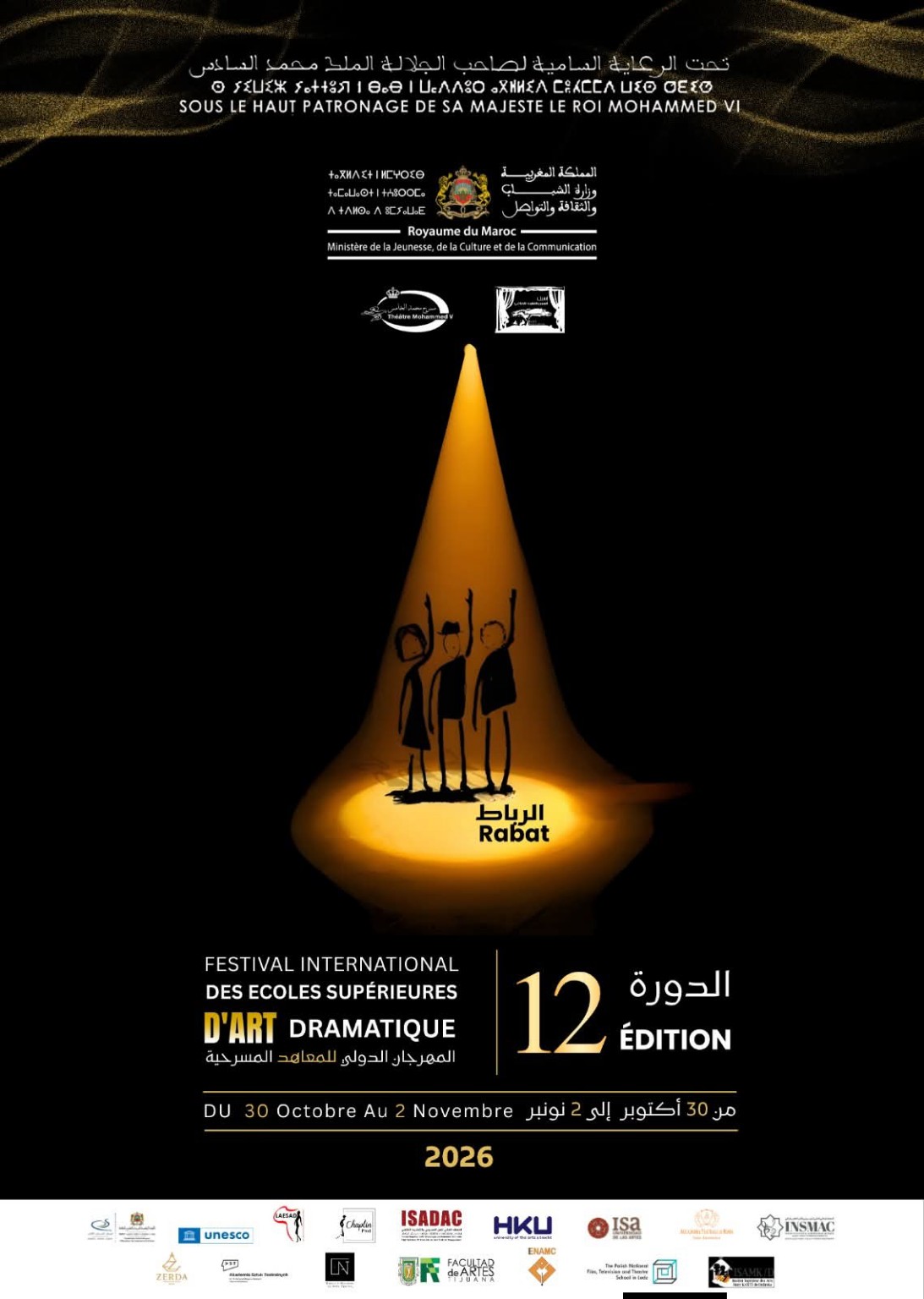
A chicken that sets off a war, a revolutionary confronting political violence, and ordinary people whose convictions collapse under pressure: from October 30 to November 2, Rabat hosts the 12th International Festival of Higher Schools of Dramatic Art, bringing the next generation of theatre makers into a shared conversation about the world.
Rabat, October 13, 2026 — A chicken eats peanuts in a neighbour’s field and a dispute spirals into war. Elsewhere, a young woman faces the violence of the French Revolution. A son reconstructs the life hidden behind his father’s police uniform. These stories, drawn from different countries and theatre traditions, will meet during FIESAD 2026, the International Festival of Higher Schools of Dramatic Art, taking place in Morocco’s capital from October 30 to November 2.
Organised by the Issil Association for Theatre and Cultural Animation under the High Patronage of King Mohammed VI, the festival places emerging artists and drama schools at the centre of an international artistic exchange. According to the organisers, more than fifty schools from four continents have participated since the festival began in 2015.
Its ambition extends beyond a programme of performances. FIESAD brings institutions into dialogue and allows young actors, directors and other practitioners to compare working methods, artistic traditions and ways of approaching audiences.
War and identity on the international stage
Several announced productions take up the fractures of contemporary life. Senegal’s Graine de la discorde (Seed of Discord), staged by the National School of Arts and Cultural Professions, begins with a seemingly trivial dispute between neighbours. A chicken eats a few peanuts; retaliation follows, and conflict spreads from a village to rival kingdoms and colonial powers. Written and directed by Abdel Kader Diarra, the work uses a fable to examine pride, revenge, failed mediation and the possibility of peace.
The Italian Dog Boy explores the consequences of war rather than its origins. Presented by the Sofia Amendolea Theatre Academy in Rome, and written and directed by Paolo Alessandri, the piece unfolds in an imaginary landscape divided by walls. Communities perceive one another as threatening strangers, gradually revealing how easily the label of “other” can reverse direction.
Although their narrative worlds are different, both works ask what happens when societies replace dialogue with suspicion, and how a collective identity is reshaped by violence.
From Morocco to Cuba: power and moral choices
Morocco’s Higher Institute of Dramatic Art and Cultural Animation (ISADAC) brings Double Face, written by Mohcine Zeroual and directed by Anas Tabite. Confined in a closed environment and confronted with hunger, waiting and uncertainty, three symbolic characters gradually reveal their contradictions. The production uses psychological tension and absurdity to explore the fragile boundary between solidarity and selfishness when survival becomes the overriding concern.
In Charlotte Corday, Cuba’s University of the Arts revisits the assassination of Jean-Paul Marat during the French Revolution. Written by Nara Mansur Cao, directed by Lizette Silverio Valdés and performed by Lianet Romero, the play considers political conviction, violence and the moral ambiguities of historical action. Its characters are historical figures, but the questions are recognisably contemporary.
Mexico’s Faculty of Arts in Tijuana, part of the Autonomous University of Baja California, presents El Rayo. Through a son’s memories, this ethnographic drama reconstructs the life of Raymundo Muñoz, tracing the relationship between personal ambition, police authority, institutional corruption and sacrifice. Written and performed by Alan Raymundo Muñoz Villavicencio and directed by Isela Yaneth Solis Ramos, it questions whether a person’s identity can be captured by the authority of a uniform.
Humour and the possibility of common ground
Not every work approaches the human condition through tragedy. Happy Go Lucky, from the National Film School in Łódź, Poland, adapts Mike Leigh’s film for the stage. Poppy is an incurable optimist who begins driving lessons after her bicycle is stolen. Her instructor, Scott, is irritable, cynical and almost her exact opposite. Directed by Marcin Brzozowski, the adaptation explores their conflicting outlooks and the possibility of understanding across everyday differences.
Other announced productions include (Des) Encuentro (Re) Encuentro (Nos) Encuentros, from Mexico’s National School of Theatre Arts, and TOTAL LOSS, revived by third-year acting students at the Netherlands’ HKU Theater. Together, the productions reveal a range of approaches, from contemporary fable and historical drama to comedy and experimentation.
More than performances: theatre education across borders
What makes FIESAD distinctive is its educational focus. Students are not merely showcasing finished productions; they are encountering different methods of acting, directing, writing and scenography, often within unfamiliar artistic traditions.
The announced international jury brings experience from performance, teaching and cultural management. Its members include Moroccan dramaturge Mohammed Boubbo, French arts administrator Marjorie Jalladot, actor and director Wahid Chakib, Spanish performer and teacher Lola Botello, and Moroccan actor and cultural mediator Mohamed Ayad.
The festival also connects with the African League of Higher Schools of Dramatic Art (LAESAD), established in Rabat in 2018. Such networks raise important questions about access to professional training, exchange of expertise and cooperation among arts institutions, particularly in Africa.
It is this dimension that may provide the festival’s most enduring legacy: relationships formed in rehearsal rooms, workshops and conversations that continue after the performances have ended.
Four days at Rabat’s Mohammed V National Theatre
The festival opens at the Mohammed V National Theatre on Friday, October 30, with an opening ceremony scheduled for 7 p.m. and Morocco’s Double Face at 7:30 p.m.
On Saturday, October 31, Mexico’s El Rayo is scheduled for 3:30 p.m. in the Kenfaoui Hall, followed by Italy’s Dog Boy at 8 p.m. Other performances and exchange activities continue through November 2. Visitors should confirm additional times and admission arrangements with the organisers.
The significance of FIESAD is not simply that it puts multiple countries on the same programme. At a time of conflict and division, it gives emerging artists a place to confront unfamiliar viewpoints through the shared language of performance.
Theatre cannot settle political disputes or erase borders. It can, however, illuminate the stories behind them, challenge comfortable assumptions and open a space for dialogue.
For four days, Rabat will be more than a host city for international performances: it will be a laboratory for what theatre might become.
Explore FIESAD 2026 and its performance listings on Culturama.