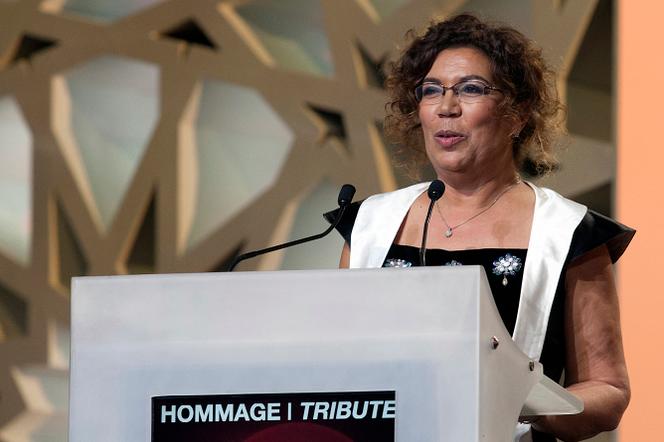
Laïla Marrakchi returns to feature filmmaking with La Más Dulce — a title that can be translated as “The Strawberries” — centred on Hasna, a Moroccan woman employed on farms in southern Spain.
The project marks an important shift in the filmmaker’s work. After exploring social, family and generational tensions in Morocco, she now looks at women who cross the Mediterranean for seasonal employment and who often remain absent from dominant narratives.
A heroine facing a system
Hasna is not simply the victim of one employer or an isolated incident. Her journey opens up a wider examination of a recruitment system built on economic vulnerability, administrative dependence and distance from home.
The film addresses working conditions, harassment, power relations and the difficulty of reporting violence when an entire family’s income depends on a contract.
By placing this story at the centre of a Moroccan, French and Spanish co-production, Laïla Marrakchi turns a social issue into a Mediterranean narrative. The borders are not only geographical: they also separate those who organise the circulation of labour from those who carry its human cost.
Moroccan cinema changes its focus
Marock established Laïla Marrakchi as a filmmaker capable of provoking public debate in Morocco. Rock the Casbah later explored the unspoken tensions of a privileged family.
With La Más Dulce, she moves away from those social circles to focus on women whose lives are rarely portrayed with complexity. The shift matters: it shows that Moroccan cinema can combine accessible storytelling, an authorial perspective and transnational social issues.
This development comes as Morocco seeks to strengthen its production capacity. Argan Studios and its ambition for the audiovisual value chain reminds us that infrastructure only becomes meaningful when it allows local and regional stories to exist.
Showing without reducing
Filming precarious lives always carries a risk: trapping characters in suffering or using their experience as a simple social demonstration.
The strength of the project will therefore depend on the space given to Hasna’s subjectivity. What are her desires, contradictions, humour, relationships and strategies? How does solidarity between workers emerge? What remains of the experience once the contract ends?
Cinema can make an injustice visible, but its deepest power appears when audiences encounter a character who cannot be reduced to that injustice.
The cultural work behind a film
A work of this kind depends on extensive documentary research, from writing to directing performers. It also requires close attention to language, accents, professional gestures and filming conditions.
International co-productions provide access to funding and wider distribution. They can also create imbalances in artistic decision-making. Preserving the film’s point of view while working with several partners will be one of the challenges of its reception.
The development of such works is connected to the wider issue of access to careers in the sector. The programmes presented in our article on cultural and creative industry projects for young talent show that a cultural ecosystem is not limited to visible authors: it also includes technical crews, production, distribution and professional support.
Why this film matters
La Más Dulce arrives at a time when migration is often discussed through statistics, border controls or political crises. Focusing on a seasonal worker brings the debate back to everyday reality: food consumed in Europe is also the product of human journeys, temporary contracts and unequal power.
By giving this experience a face, a voice and duration, Laïla Marrakchi may help shift the public gaze. The film will not only concern movement between Morocco and Spain, but dignity, labour and a woman’s decision to no longer accept silence.