Morocco and the European Union are strengthening cooperation in the cultural and creative industries through three projects aimed at young talent, cultural entrepreneurs and creative-sector organisations.
Launched in Rabat, the programmes seek to connect artistic creation with training, professional networks, business development and international cooperation.
The initiatives reflect a wider shift explored in Culturama’s analysis of Morocco’s cultural and creative industries: culture is increasingly recognised as both a public good and a source of employment, innovation and territorial development.
A new phase for Morocco’s creative ecosystem
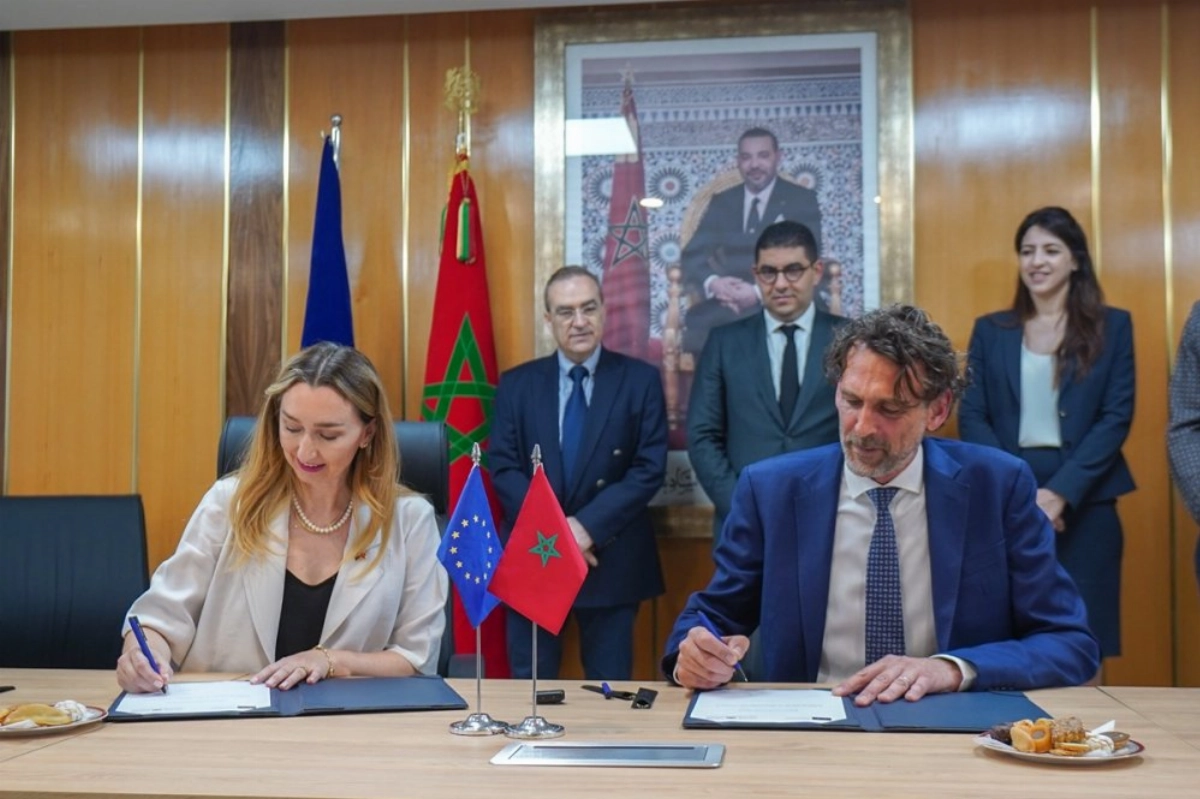
The launch brought together Mohammed Mehdi Bensaid, Minister of Youth, Culture and Communication, and Dimiter Tzantchev, Ambassador of the European Union to Morocco.
Selected through a call for proposals, the three projects are led by Africalia, the Goethe-Institut and Fondation Hiba with Moroccan and European partners. Their shared objective is to help young creators move from an artistic idea to a structured, sustainable project connected to professional opportunities.
This transition is often the hardest stage. Talent alone does not provide access to accounting, contracts, distribution, financing, communication, intellectual-property advice or international markets.
IQLAA: accelerating young cultural enterprises
IQLAA, Your Cultural Accelerator is led by Africalia in partnership with Fondation Hiba and the Institut français.
The programme is designed to support young businesses operating in the cultural and creative industries. It focuses on strengthening project structures, business models and development capacity.
For emerging Moroccan cultural entrepreneurs, mentoring and professional networks can be as important as initial funding. The programme treats cultural entrepreneurship as a genuine professional field capable of producing employment, revenue and new forms of artistic expression.
Its long-term value will depend on the durability of the supported organisations: their ability to diversify income, retain teams, reach audiences and continue operating after the acceleration period.
Hi-Fenn: connecting Moroccan and European ecosystems
Hi-Fenn — Connect, Create, Resonate is led by the Goethe-Institut with Fondation Ali Zaoua and Wallonie-Bruxelles International.
The project emphasises exchange between Moroccan and European cultural professionals. It aims to encourage artistic co-creation, shared expertise and collaboration among artists, programmers, institutions, venues and young creators across the Mediterranean.
For Morocco, this network dimension is strategic. International mobility can expand opportunities for distribution and co-production, while local organisations can gain new methods and partnerships.
The challenge is to ensure reciprocity: exchanges should strengthen Moroccan organisations and careers over time, rather than producing isolated events with little follow-up.
Creative Morocco Gate: information, networks and opportunities
Creative Morocco Gate is led by Fondation Hiba with the Association of Independent Radio and Television Broadcasters.
Its purpose is to improve cultural entrepreneurs’ access to information, professional networks, funding and development opportunities.
Cultural information is frequently fragmented across calls for projects, residencies, training schemes, grants, professional markets and distribution opportunities. This particularly affects creators working outside major institutional circuits or Morocco’s largest cities.
A useful gateway must therefore do more than aggregate announcements. It should make opportunities searchable, explain eligibility, provide reliable deadlines and help users understand which programmes fit their stage of development.
Why these projects matter
Film, music, publishing, digital arts, heritage, festivals, media, design, gaming and cultural events all combine artistic, technical and entrepreneurial skills. Supporting these sectors can contribute to youth employment, attractive territories and Morocco’s cultural presence internationally.
But project funding should be measured through outcomes rather than activity counts alone. Relevant indicators include:
- businesses still active after support ends;
- jobs and paid contracts created;
- revenue diversification;
- works produced and distributed;
- access to national and international markets;
- territorial and gender inclusion;
- collaborations that continue beyond the programme.
The three initiatives address complementary needs: enterprise development, international connection and access to information. Together, they can help a new generation of Moroccan cultural actors become better equipped, more visible and more sustainable.