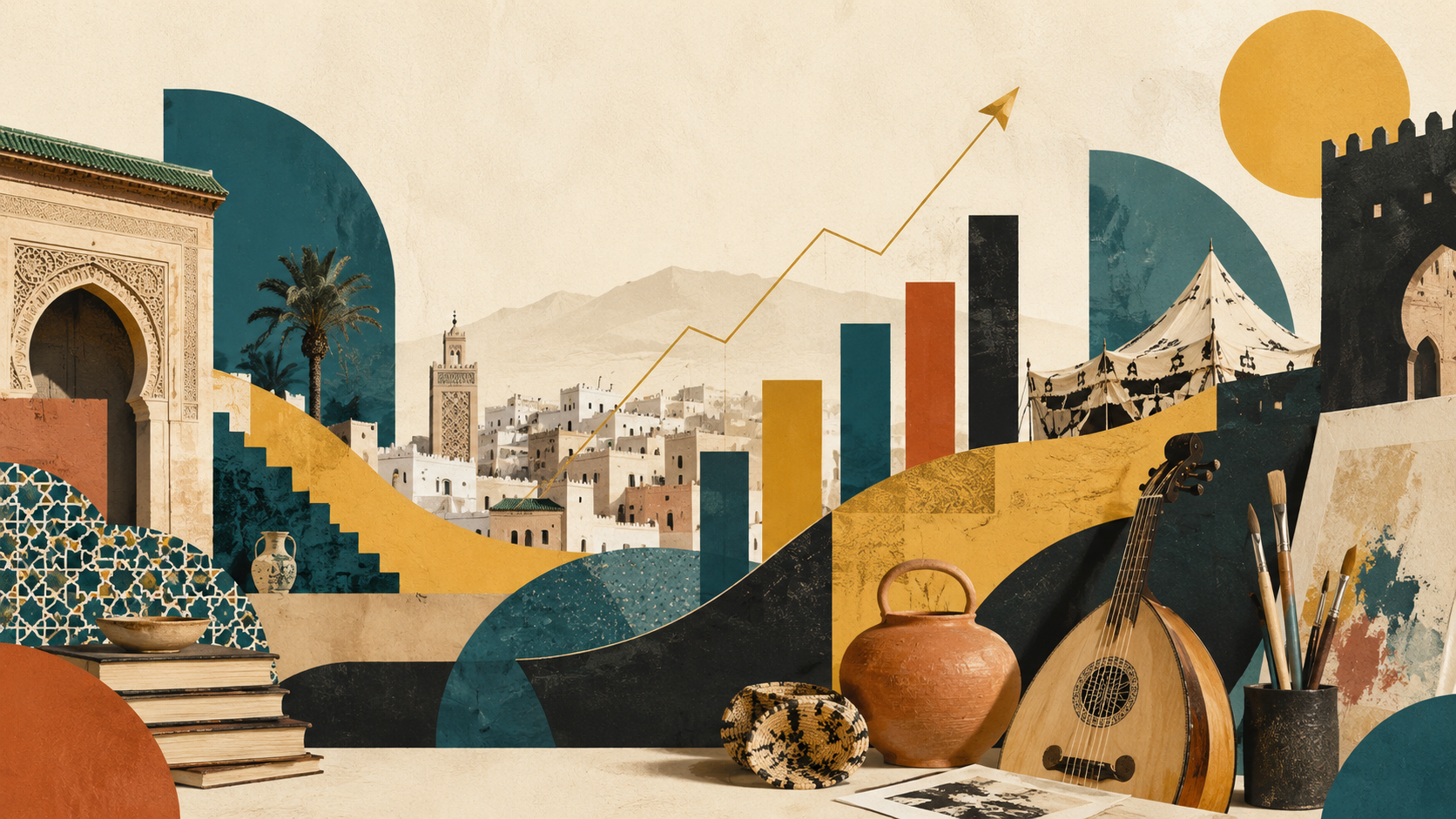
Still treated as a cost, culture is already an economy.
MAD 43 billion in revenue. More than 116,000 jobs. Around 2.4% of Morocco’s GDP. The figures released in 2026 by the International Finance Corporation (IFC) paint a picture of a creative economy far larger than the one usually reflected in public debate. Yet they also expose a striking contradiction: Morocco’s cultural and creative industries are growing, creating jobs and generating activity across entire cities, while the vast majority of businesses in the sector continue to operate with little or no access to finance.
There is a familiar reflex whenever culture enters the public conversation in Morocco: we tend to start with what it costs. How much did the festival cost? How large was the subsidy? How much public money went into a film, a venue or a cultural programme? Those are legitimate questions, particularly when public funding is involved. But they often overshadow another question that receives far less attention: how much economic value does culture actually generate?
A major assessment published in April 2026 by the International Finance Corporation, the private-sector arm of the World Bank Group, offers one of the clearest answers yet. According to the IFC, Morocco’s cultural and creative industries (CCIs) generated an estimated MAD 43 billion in revenue in 2023, including formal, informal and non-profit activity. Turnover across the sector increased by roughly 18% between 2022 and 2023, while its contribution to the Moroccan economy was estimated at around 2.4% of GDP in 2022.
At that scale, culture can no longer be treated as a peripheral activity that the “real economy” occasionally agrees to support. It is already part of that economy.
An economy hiding in plain sight
One reason Morocco’s creative economy remains difficult to grasp is that it does not look like a conventional industry. There is no single vast factory labelled “culture”, employing thousands of people behind the same gates. Instead, the sector is scattered across thousands of businesses, freelancers, workshops, studios and organisations.
It can be an artisan workshop in Fez, an audiovisual studio in Casablanca, a publishing house in Rabat, an event-production company, an architect, a designer, a music producer, a photographer, a digital platform or a heritage-based tourism business. Taken individually, many of these operations may appear small. Taken together, they form an economy worth tens of billions of dirhams.
And even that number does not tell the whole story. Of the estimated MAD 43 billion generated in 2023, roughly MAD 34 billion came from formal economic activity. Close to one-fifth of estimated CCI revenue therefore sits within informal or non-profit activity.
That matters because the invisible part of the creative economy is not imaginary. It consists of real people doing real work: artists paid project by project, freelance technicians, craftspeople, small collectives, independent creators and businesses whose income may fluctuate significantly from one month to the next.
The value exists. What is often missing is a financial footprint that conventional institutions know how to read. And what is difficult to measure is usually difficult to finance.
A festival is never just a stage
Sometimes the economic meaning of culture becomes easier to understand once we leave the spreadsheets behind.
Take Essaouira. During the Gnaoua and World Music Festival, culture does not remain confined to concert stages. Demand spills across the entire city. Visitors need somewhere to sleep, somewhere to eat and ways to move around. Hotels and guesthouses fill up. Restaurants, cafés, taxis, retailers, technical crews, production companies and temporary workers all participate in an economic chain triggered by a cultural event.
A visitor who pays for a hotel room, eats at a restaurant and takes a taxi does not appear in official accounts as spending money on “culture”. Yet without the cultural event that brought that person to the city, much of that spending may never have taken place there.
This is one reason the economic impact of culture is so easily underestimated: part of the value it creates shows up in other industries.
The same mechanism is visible elsewhere. In eastern Morocco, the Rai Festival of the Oriental Region in Oujda turns music into a city-wide moment of activity. The concerts themselves are only the most visible layer. Hospitality, food and beverage, transportation, security, technical services, communications and local commerce operate around the event.
That does not mean a festival can replace a regional development strategy. It cannot. But reducing it to a few evenings of entertainment misses the point just as badly.
In Essaouira, the relationship between culture and place extends well beyond a single festival. The city has gradually built an international cultural identity around music, heritage and recurring events, including MOGA Essaouira. What begins as cultural programming can, over time, become part of a city’s tourism offer, global reputation and economic positioning.
That is what the IFC’s MAD 43 billion figure looks like when translated from a national statistic into everyday economic life.
116,000 jobs — and most of them are not on stage
The IFC estimates that Morocco’s cultural and creative industries supported more than 116,000 jobs in 2023, including around 78,000 formal jobs. CCIs account for approximately 1% of the country’s workforce, according to the report.
Another figure is particularly revealing: the sector generates an estimated 3.7 jobs for every MAD 1 million in value added, compared with around 3.2 in manufacturing.
This is not an argument for culture replacing manufacturing. It does, however, highlight an important characteristic of the creative economy in a country where employment remains one of the most pressing economic challenges: creative industries are relatively labour-intensive.
A concert employs far more than the person standing under the spotlight. Production teams, sound engineers, lighting technicians, stage managers, photographers, designers, communications professionals, security staff, transport providers and many others form part of the same value chain.
The same applies to cinema, publishing, heritage, crafts and design. Cultural products may be what audiences see, but behind them sits an entire economy of skills and services. The question of how Morocco turns production capacity into a stronger value chain also runs through Culturama’s analysis of Argan Studios and Morocco’s ambitions for a broader African film ecosystem.
The IFC also estimates that women account for around 34% of CCI employment, a higher share than their participation in overall national employment in the comparative data used by the report. That does not automatically mean equal pay, equal access to management positions or equal access to capital. But in a country facing persistent challenges around both youth employment and women’s economic participation, the figure deserves attention.
Morocco’s creative economy is not where many people think it is
Mention the “creative industries” and many people will immediately think of film, music, festivals or digital content. The Moroccan numbers tell a broader story.
Creative arts and crafts account for roughly 43% of CCI revenue, making them the largest component of the sector, with an estimated MAD 18.5 billion in turnover and around 45,000 jobs.
A second major group — heritage, cultural tourism, architecture and gastronomy — accounts for approximately MAD 10.4 billion. Advertising and marketing generate roughly MAD 5.1 billion, while audiovisual production, cinema and multimedia account for around MAD 3.9 billion. Music generates approximately MAD 2.5 billion.
This matters because Morocco should not simply import an American or European definition of the creative economy. The country’s creative assets do not begin with streaming platforms or end with film production. A substantial part of Morocco’s cultural capital is rooted in centuries-old knowledge and practices: craftsmanship, architecture, music, food, design languages and living heritage.
A rug can be cultural heritage and an export product. Traditional know-how can be both identity and intellectual capital. Architecture can carry memory while generating commercial value. A musical tradition can belong to a community and simultaneously become an international cultural asset. Morocco’s contemporary-art presence increasingly draws on that same dialogue between heritage and creation, as seen in Culturama’s coverage of Amina Agueznay and Morocco’s first official pavilion at the Venice Biennale.
The challenge is not to commercialise everything. It is to create more value from what already exists without stripping it of the cultural meaning that made it valuable in the first place.
Morocco does not need to build a creative economy from scratch. It needs to become better at structuring the one it already has.
Then comes the uncomfortable number: 3%
This is where the IFC assessment becomes particularly revealing.
According to the financial data analysed in the report, only around 3% of businesses in Morocco’s cultural and creative industries had access to credit. Put differently, approximately 97% operated without bank financing.
In events, festivals and the performing arts, the share operating without credit rises to roughly 99%. In publishing, books and the press, it is around 96%. Overall, cultural and creative businesses received less than 0.5% of total credit extended to Moroccan companies.
That is the central contradiction. On one side: MAD 43 billion in economic activity. On the other: a sector that remains almost absent from traditional business lending.
It would be easy to stop there and blame the banks. It would also be incomplete. Conventional lenders know how to value a building, a piece of machinery or a plot of land. Those assets can be used as collateral. The creative economy works differently.
How does a bank price a screenplay? A music catalogue? A creative brand? A licence? The future rights to a film? A digital community? Intellectual property whose value may depend on a project succeeding several years from now?
Many of the most valuable assets in creative industries are intangible, while much of conventional finance remains built around tangible collateral and predictable cash flow.
Yet creative businesses face structural weaknesses of their own: fragmented companies, irregular revenue, limited financial forecasting, undercapitalisation and sometimes weak knowledge of available financial instruments.
So saying that “banks do not understand culture” is only half the story. The more useful question is: how can Morocco build a creative ecosystem that investors, lenders and guarantee mechanisms can understand, without forcing cultural businesses into economic models designed for entirely different industries?
95% are small businesses — both a strength and a weakness
The IFC identifies approximately 9,500 formal businesses operating across Morocco’s cultural and creative industries. Around 95% are micro-enterprises or very small businesses.
That statistic explains a great deal. Morocco’s creative economy is not dominated by a handful of corporations with large balance sheets, easy access to capital and the ability to absorb months of weak cash flow. It is an archipelago of small organisations and specialist businesses.
That fragmentation can be a strength. Creative sectors thrive on experimentation, niche expertise and the ability of new studios, labels, designers and producers to emerge quickly. But it is also a vulnerability.
A tiny company financing everything from its own cash can produce work. It may survive. It may even achieve a major success. Scaling is something else entirely.
Hiring before the next contract is signed, investing in equipment, financing several productions at once, developing export markets or strengthening distribution all require capital. Without it, many cultural businesses remain trapped in a familiar cycle: deliver a project, wait to be paid, rebuild cash reserves and begin again almost from zero.
The creative capacity is there. The ability to accumulate and reinvest capital is much weaker.
Funding culture is not the same as subsidising culture
This may be where the vocabulary itself needs to change.
A serious cultural policy needs public funding. Some forms of artistic, social or heritage value will never be adequately rewarded by the market. Asking every theatre company, film, book, museum or heritage practice to become commercially profitable would destroy part of what culture is meant to protect.
But viable cultural businesses need a different set of tools as well: credit, guarantees, equity, investment, export support, distribution, intellectual-property frameworks and business development.
A grant that allows a work to exist and capital that allows a company to grow are not the same thing. Morocco probably needs both.
The objective should not be to turn every artist into an entrepreneur or every festival into a profit-maximising machine. It should be to identify the parts of the cultural sector capable of developing sustainable business models and give them the financial tools to do so, while continuing to support cultural activity whose value cannot be reduced to a balance sheet.
That is when Morocco’s cultural and creative industries stop being discussed only as cultural policy and start becoming part of economic policy.
2030: Morocco will need to tell a story, not just build infrastructure
The 2030 FIFA World Cup inevitably hangs over this conversation.
Morocco is investing heavily in transport, airports, hotels, stadiums and urban infrastructure. All of that matters. But millions of visitors will not experience Morocco through infrastructure alone.
They will experience a story about the country. That story will be told through music, architecture, food, fashion, film, crafts, design, heritage, contemporary art and digital content — in other words, through the cultural and creative industries.
2030 could therefore become a major accelerator for Morocco’s creative economy. But there is a risk in treating culture as the decorative layer added once the stadium is finished.
Culture should not merely help Morocco dress up 2030. The sector should use the opportunity to build stronger companies, expand markets, protect intellectual property, develop international audiences and create structures capable of surviving long after the final match.
A World Cup is a deadline. It is not an economic model.
So, how much does culture cost?
Perhaps Morocco has been asking the wrong question for too long.
Of course we should ask what cultural policy costs. Public money should be scrutinised. Festivals, institutions and programmes should be evaluated. Cultural spending should not somehow be exempt from accountability.
But the conversation cannot stop there anymore.
Four figures from the IFC report deserve to remain at the centre of the debate: MAD 43 billion in revenue. More than 116,000 jobs. Around 2.4% of GDP. And only 3% of businesses with access to credit.
Together they describe an economy large enough to matter, but still too fragile to realise its full potential.
When Essaouira fills with visitors drawn by Gnaoua music, when Oujda brings audiences together around raï, when Moroccan craftsmanship reaches international markets or when a local studio sells creative work abroad, the boundary between “culture” and “the economy” becomes much less obvious than we often pretend.
Moroccan culture is not waiting to become an economy.
It already is one.
The question now is why we still so often treat it as a cost.