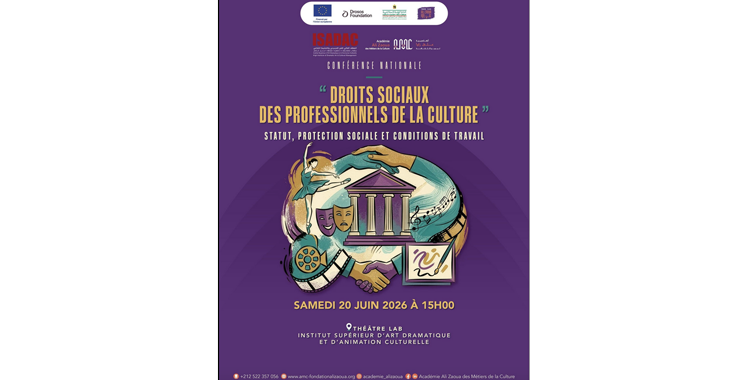
The social rights of cultural professionals were the focus of a national conference in Rabat addressing a central question for Morocco’s cultural ecosystem: how can the country better recognise, protect and support the people working in creation, production, mediation and cultural transmission?
Organised by Fondation Ali Zaoua through the Ali Zaoua Academy for Cultural Professions, in partnership with the Higher Institute of Dramatic Art and Cultural Animation (ISADAC), the conference took place at ISADAC’s Théâtre Lab.
The discussions covered artists’ legal status, social protection, contracts, self-employment and the everyday realities of cultural work.
Culture is also a labour issue
Cultural policy is often discussed through creation, programming, heritage or international visibility. Behind every performance, exhibition, film, workshop and festival, however, are artists, technicians, trainers, cultural managers, producers and freelancers.
Many careers remain shaped by short contracts, irregular income, informal work and incomplete social protection. The cultural sector cannot become sustainable if the people who produce its value remain economically vulnerable.
This connects cultural policy with labour law, social security, taxation, professional training and access to finance. It also means that a single legal category cannot necessarily reflect the diversity of work across theatre, music, film, visual arts, heritage, festivals and digital creation.
Artists’ status, contracts and social protection
The programme combined institutional presentations, study findings, a professional panel and an open forum.
Latefa Ahrare, director of ISADAC, and Mahmoud Chahidi, director of the Ali Zaoua Academy for Cultural Professions, opened the meeting. Anissa Agbi presented findings from an evaluation of the Academy.
The main panel brought together Azzedine Bounit, Bouhcine Messaoud and Azhar Mohammed to discuss the legal framework, labour rights, contracts and self-employed status.
These subjects are closely linked. A cultural worker may alternate between salaried employment, service contracts, royalties, project grants and unpaid development time. Protection systems designed around continuous employment can struggle to cover such fragmented careers.
An open forum for institutions and young professionals
The conference included an agora connecting public institutions, trainers, students, artists and professionals.
The exchange focused on professional integration, access to rights, working conditions, social protection and the support needed by young people entering cultural occupations.
This intergenerational dimension matters. Training provides artistic and technical skills, but professional entry also requires knowledge of contracts, invoicing, copyright, negotiation, taxation and social-security procedures.
Institutions and training providers can reduce vulnerability by integrating these topics into curricula rather than leaving graduates to discover them through disputes or unpaid work.
What stronger protection would require
Improving conditions across cultural occupations involves several complementary measures:
- clear written contracts for commissions and performances;
- transparent rules on pay, expenses, cancellation and intellectual property;
- social-protection mechanisms adapted to intermittent and multi-employer careers;
- accessible information on legal status and administrative procedures;
- reliable data on employment, income and unpaid labour;
- stronger collective representation and professional dialogue;
- enforcement mechanisms that remain accessible to freelancers and small organisations.
The debate also intersects with generative AI and the value of human creative work. New tools can accelerate production, but they also create new questions about consent, attribution, copyright and remuneration.
Professionalising the ecosystem
Through this conference, the Ali Zaoua Academy for Cultural Professions reinforces its role in skills development and sector professionalisation.
The Academy develops training programmes, professional meetings and spaces for exchange tailored to Morocco’s cultural and creative industries. Such initiatives are valuable when they connect training to actual employment conditions and give early-career professionals practical tools to defend their rights.
A stronger Moroccan cultural economy cannot be measured only through venues, festivals or creative-industry revenue. It must also be measured through the quality of work it creates: fair contracts, predictable remuneration, protection against risk and viable long-term careers.
Practical information: 20 June 2026 · Théâtre Lab, ISADAC, Rabat · Organised by Fondation Ali Zaoua / Ali Zaoua Academy for Cultural Professions with ISADAC · Supported by the European Union in Morocco, INDH and Fondation Drosos.
