Babelfan.ma, the doorway that brought Moroccan culture online
Babelfan.ma connected cultural events, artists and venues within a single Moroccan platform. A look back at a pioneering project in Morocco’s cultural web history.
Lire en français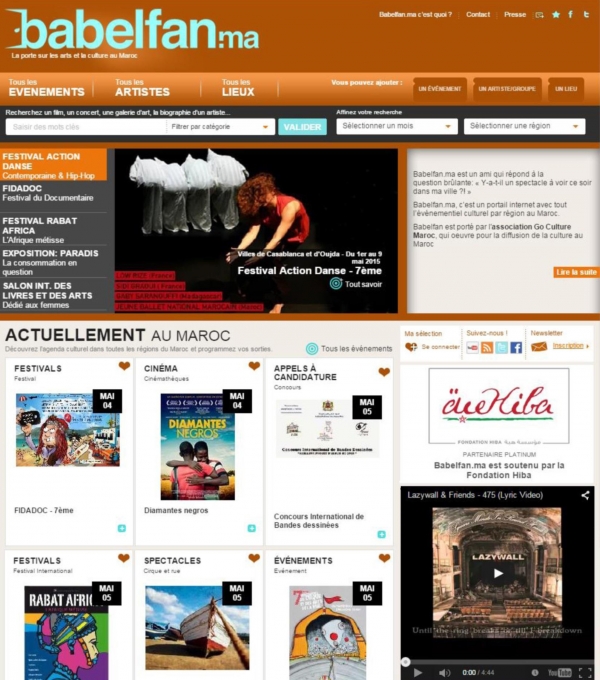
Before cultural events circulated mainly through stories, WhatsApp groups and sponsored posts, there was already a simple question to answer: what is happening culturally in Morocco?
For years, Babelfan.ma tried to answer it by bringing together, in one digital space, the events, artists and venues that animated Morocco’s cultural scene.
Its address no longer holds the place it once did in the public’s habits. Yet the idea behind Babelfan remains familiar to anyone still looking for a concert, an exhibition, a theatre performance, a screening or a literary encounter without knowing exactly where to search.
Some websites disappear without ever fully leaving the memory of the web. Babelfan.ma belongs to that category.
Before stories, a place to search
Cultural information has always circulated. It moved through posters, printed programmes, press releases, radio, newspapers, newsletters and, above all, word of mouth.
Digital technology did not eliminate that fragmentation. At times, it intensified it.
Today, a poster may appear for a few hours in a story, be forwarded on WhatsApp and then become almost impossible to find. Each venue, festival, gallery or collective speaks to its own community. Audiences easily discover what they already follow, but find it much harder to encounter what they do not yet know.
Babelfan addressed this problem through a simple idea: create a shared space where people could search for cultural activity by city, date or discipline.
The site was not merely a stream of announcements. It presented itself as a cultural information platform for Morocco, designed to make the artistic landscape easier to read and to bring audiences closer to what was being created around them.
Three databases to describe an ecosystem
One of Babelfan’s most interesting ideas was its organisation around three interconnected databases:
- events;
- artists;
- cultural venues.
This architecture may seem obvious today, but it already expressed a thoughtful understanding of the cultural ecosystem.
An event never exists on its own. It is carried by artists, hosted by a venue, produced by an organisation and rooted in a territory. By connecting these elements, Babelfan moved beyond the role of a simple calendar. It gradually built a digital map of culture in Morocco.
The Fondation Hiba 2015 activity report describes a free cultural agenda providing daily information on current and upcoming events across Morocco’s regions. It also explains that the platform highlighted cultural actors through its event calendar, artist biographies and descriptive venue profiles.
That approach remains highly relevant. Understanding a cultural scene requires more than knowing that a performance will take place on Friday night. Audiences should also be able to discover the artist’s journey, the history of the venue and the other initiatives surrounding it.
The same principle of circulation can be found today in a cultural events platform connected to cities, disciplines and venues.
The invisible work behind an event listing
A cultural calendar looks simple until one has tried to build one.
Behind every listing are research, verification, selection, an image to find, a schedule to confirm, a category to choose and sometimes several exchanges with the organiser. Programme changes must be corrected, cancelled events removed and information published early enough for audiences to make real plans.
This work is editorial as much as it is technical.
Choosing what information to display, deciding how to introduce an artist or organising artistic disciplines already amounts to offering a reading of culture. A database is never entirely neutral: it reflects the realities that someone has taken the time to document.
Babelfan understood that a useful cultural tool had to combine the rigour of data with the sensitivity of mediation. The site made events visible, but it also helped give artists and venues a more durable digital presence, including those that were poorly documented elsewhere.
This function matters greatly in a sector where archives remain fragile. Pages disappear, domain names change and social posts vanish into the feed. Over time, a well-structured profile can become a record of the cultural activity of an era.
Go Culture Maroc and Fondation Hiba’s support
Babelfan was led by the non-profit Association Go Culture Maroc. Fondation Hiba supported the project, notably by making a workspace available to the association.
This support is a reminder that a digital platform is never born from a good idea or a technical build alone. It needs a team, time, partners, regular contact with the field and an environment capable of helping it endure.
Through its spaces and programmes, Fondation Hiba developed an approach in which digital tools complemented physical cultural infrastructure. Venues such as Cinéma Renaissance and HibaLab illustrate this connection between presentation, support, creation and encounters with audiences.
A cultural website does not replace a theatre, gallery or studio. It builds bridges between them. It helps audiences identify these places, artists reach new people and programmes circulate beyond their immediate communities.
An editorial infrastructure before a platform
In the language of digital media, we often speak about interfaces, features, search optimisation and user experience. All of these matter. But the real value of a cultural media platform begins with trust.
Audiences must be able to believe that a date is correct. Artists must recognise themselves in the way they are presented. Venues must be identifiable. Organisers must know how to submit information or request a correction.
Technology alone cannot produce that trust. It grows through consistency and editorial care.
Babelfan helped establish an essential idea: cultural information deserves dedicated infrastructure. It should not depend only on social-media reach or on each organiser’s communication budget.
This intuition connects with current debates around Morocco’s cultural and creative industries. Supporting creation also means supporting the tools that make it visible, understandable and accessible.
Discoverability as a cultural issue
Today’s digital environment relies heavily on algorithmic recommendation. Platforms offer us content similar to what we have already liked, watched or shared.
That personalisation can be useful, but it can also reduce the possibility of surprise.
An independent cultural calendar works differently. It allows audiences to browse a city, date or discipline without ranking everything solely by popularity. It gives a small venue, a first exhibition or an emerging collective a chance to appear in the same space as a major institution.
This ability to be found has a name: discoverability.
For culture, it is decisive. A work or event can exist, be excellent and remain invisible if audiences do not have the right paths to reach it.
Babelfan created one of those paths.
Honouring the projects that came before us
The digital world often has a short memory. Every new initiative wants to appear as a rupture, a first or an absolute innovation.
Yet platforms are always built within a history. They take up earlier intuitions, learn from past experiences and respond to needs that others had already identified.
Recognising Babelfan does not mean idealising the site or claiming that it would meet every contemporary need. The web has changed, mobile habits have become dominant and expectations around design, geolocation, multilingual access and structured data have evolved considerably.
It means recognising pioneering work: bringing scattered information together, linking events with artists and venues, and affirming that Moroccan culture deserved its own digital tools.
For Culturama, returning to this history is not a claim to official succession. It is an acknowledgement of lineage and responsibility.
A cultural ecosystem does not grow by erasing what came before. It grows by preserving traces, sharing lessons and recognising the work already done.
Babelfan.ma may no longer be the digital reflex it once was.
But the doorway it opened onto Moroccan culture online never fully closed.