Part of Culturama’s MOROCCAN CULTURE 2011–2026 series: Cultural governance · Cultural funding · The real economic weight of Morocco’s creative industries.
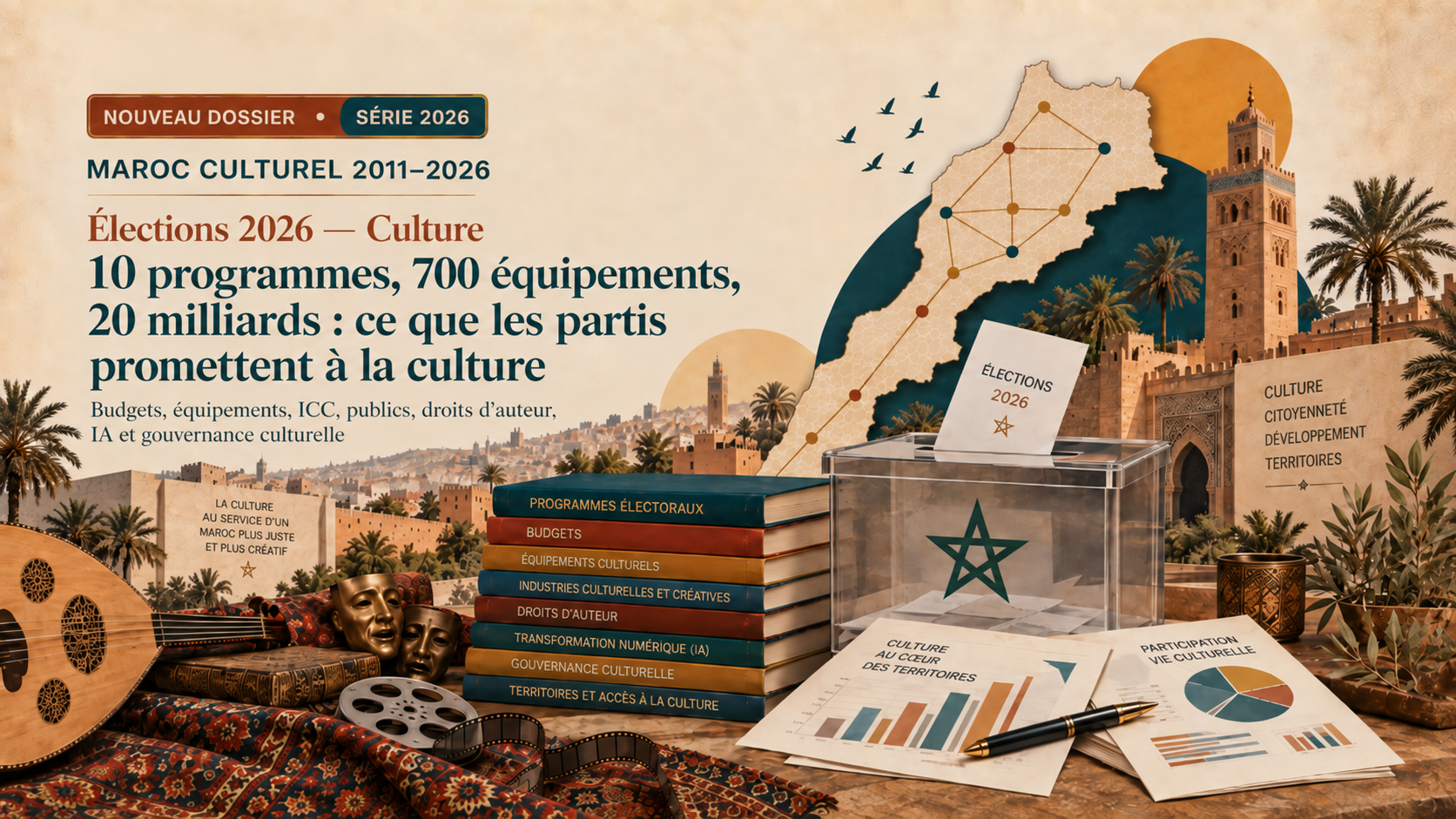
Eight days before Morocco’s 23 September 2026 legislative election, cultural policy has rarely been presented with so many figures. Culturama examined ten party programmes covering budgets, infrastructure, cultural and creative industries, heritage, employment, copyright, artificial intelligence and access to culture.
The programmes are far better at counting what they want to build or spend than at explaining how cultural participation, creative businesses and public impact will be measured.
The 1% promise
The most visible figure is 1%. The USFP explicitly proposes bringing the cultural sector’s budget to 1% of the State General Budget. The PPS also sets a 1% objective, although its document uses a different public-spending denominator. Other left-wing programme documents require similar caution because references to 1% and 2% do not always describe the same base.
Using the 2026 General Budget as a common benchmark, Culturama estimates that 1% would equal approximately MAD 5.92 billion a year. The Culture Department’s 2026 allocation is around MAD 1.427 billion. Reaching 1% on this basis would therefore multiply the current allocation by roughly 4.15 and require close to MAD 4.5 billion in additional annual funding.
This is a Culturama simulation, not an official party costing. It nevertheless shows that the slogan implies a complete change of scale.
The PPS: funding supply and demand
Among the programmes examined, the PPS goes furthest in quantifying its proposals: MAD 20 billion in additional cultural investment over five years, 300 cultural institutions, 100 multifunctional spaces, 150,000 creative-industry jobs, 100 cultural startups and a target of 4% of GDP for the cultural and creative industries.
Its most distinctive proposal is an annual MAD 1,000 culture voucher for two million low-income households. At full scale, this could represent up to MAD 2 billion a year.
Unlike policies focused only on venues, productions or organisations, this mechanism would directly support cultural demand. Its effectiveness would depend on eligibility, accepted goods and services, participating operators and measurable changes in participation.
RNI: a large employment figure that needs qualification
The RNI programme mentions 300,000 jobs, but this aggregate covers tourism, services, culture, arts and entertainment together. It should not be presented as 300,000 cultural jobs.
Without a sector-by-sector baseline, it would be difficult to determine later how many jobs were created in music, publishing, gaming, design, audiovisual production or live performance. Large aggregates generate strong announcements but weak accountability.
Four competing visions of culture
The programmes reveal four broad approaches:
- Culture as a right and public service, emphasising territorial equality, libraries, local facilities and access.
- Culture as an industry, framed through GDP, businesses, startups, employment, investment and exports.
- Culture as identity and cohesion, focusing on languages, values, heritage and national narratives.
- Culture as influence and sovereignty, linking domestic production, audiovisual content, heritage and international reach.
These approaches can overlap. The deeper question is whether culture is treated as an autonomous public policy or mainly as an instrument of economic, territorial, identity or diplomatic policy.
700 venues and the “concrete trap”
The quantified commitments of the PPS and USFP together represent around 700 cultural venues or spaces to be created, developed or renovated.
Territorial inequality is real. Yet Court of Auditors data show that more than MAD 6.48 billion was invested in cultural infrastructure between 2018 and 2024. By the end of that period, 1,176 institutions were in operation, but only 380 municipalities—roughly one quarter of the country’s communes—had infrastructure within the reviewed scope. Another 81 facilities remained unused, representing around MAD 305 million in underutilised investment.
Construction alone does not create a cultural service. Every venue needs staff, operating funds, maintenance, programming, technical capacity, communication, mediation and audiences. Capital expenditure without operating expenditure and a participation strategy risks producing buildings rather than cultural life.
The missing public
Household spending data add another concern. According to the HCP, the share of consumption allocated to “leisure and culture” fell from 1.9% in 2014 to 0.5% in 2022. The period includes the pandemic and pressure on household budgets, so this cannot be read as a simple decline in cultural interest.
It does show why artistic education, mediation, pricing, transport, opening hours and cultural information deserve the same attention as infrastructure. The PPS sets some measurable objectives, including training 5,000 arts teachers. Most other programmes are less precise about audience development.
From promises to indicators
The central weakness across the programmes is not the absence of ambition. It is the limited connection between inputs and results.
A credible cultural policy dashboard would distinguish:
- public funding and private investment;
- active venues, not merely completed buildings;
- audience numbers, frequency and territorial distribution;
- sustainable cultural employment by sector;
- business survival, exports and revenue;
- artists’ social protection and income;
- access for children, rural residents and low-income households;
- copyright revenue and digital-platform accountability.
The 2026 campaign shows that culture has entered electoral language through billions, jobs and facilities. The next step is harder: turning figures into costed measures, delivery responsibilities and outcomes the public can verify.