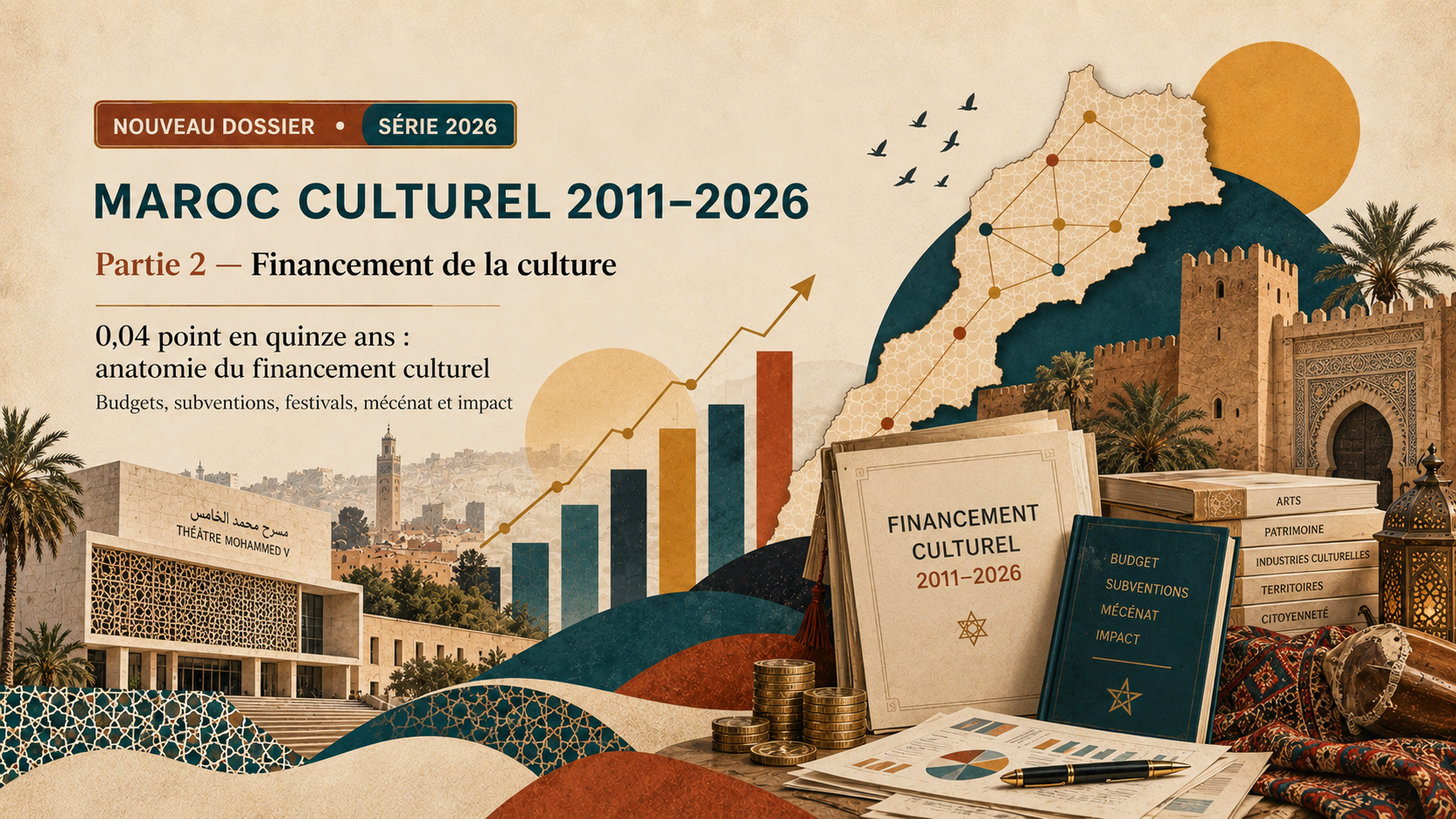
Part 2 of Culturama’s series on cultural policy in Morocco, 2011–2026. Read Part 1: Cultural governance.
Between 2012 and 2026, Morocco’s Culture budget rose from MAD 573.974 million to MAD 1.427 billion—an increase of almost 149% in nominal terms.
Over the same period, expenditure under the State General Budget grew from roughly MAD 289.7 billion to MAD 591.8 billion. Culture’s share therefore moved from around 0.198% to 0.241%.
The result is a useful paradox: far more dirhams, but only about 0.043 percentage points of additional priority in fourteen budget years. Culture still represents less than one quarter of 1% of the General Budget.
The ministry’s allocation is not the whole cultural economy
The Culture Department’s MAD 1.427 billion allocation is not a consolidated national culture budget. Other funds circulate through the National Fund for Cultural Action, the Moroccan Cinematographic Centre, the National Museums Foundation, territorial authorities, public institutions, infrastructure agreements, foundations, private sponsorship and international cooperation.
Because these flows are not brought together in one simple annual account, it remains difficult to establish the total amount invested in culture across public, territorial, private and international sources.
This fragmentation is not merely statistical. It makes it harder to compare priorities, trace territorial distribution and evaluate the combined impact of funding.
A system still structured by the 2013 framework
A large part of direct cultural aid continues to rely on Decree No. 2.12.513 of 13 May 2013. The model is familiar: an open call, application file, committee review, selection, agreement and subsidy.
Sector rules later adapted this architecture to theatre, books, music, visual arts, associations and festivals. Successive governments have changed amounts, criteria and monitoring, but the basic funding mechanism has remained remarkably stable.
Political alternation has therefore not produced an equivalent alternation in cultural-finance architecture. The system has evolved by adding layers—co-financing, territorialisation, impact criteria and reporting—rather than by replacing its underlying logic.
The Akhannouch period: adjustment rather than revolution
Theatre residency, or tawtin, illustrates this incremental change. Earlier rules could cover up to 70% of project costs. In 2026, the maximum public share fell to 60%, while project size and grant ceilings increased and monitoring requirements became stronger.
The direction is clear: lower proportional dependence on one public funder, larger projects, more co-financing and more contractual accountability.
This may improve leverage, but it can also disadvantage smaller organisations with limited cash flow or fundraising capacity. The quality of the reform therefore depends on whether new requirements are matched by support for professionalisation.
At least MAD 51.8 million in identifiable direct aid in 2026
Published results available by 8 September 2026 identify at least five major blocks:
- Books and publishing: 485 projects supported out of 862 applications, for MAD 12.5658 million.
- Associations, festivals and cultural events: 240 projects out of 852, for MAD 8.63 million.
- Visual arts: 72 projects out of 102, for MAD 7.838 million.
- Music, song and performing arts: MAD 7.15 million in the first session.
- Theatre: MAD 15.595 million in the first session.
Together, these amount to MAD 51.7788 million. This is a minimum, not a final annual total, and it should not be added mechanically to the departmental budget because part of it is financed within that architecture.
Demand is rising faster than some allocations. Applications for support to associations and festivals increased from 546 in 2022 to 852 in 2026—around 56%—while funding rose only about 12%, from MAD 7.685 million to MAD 8.63 million. The number of supported projects declined from 257 to 240.
Why theatre remains structurally dependent on public support
Not all cultural activities have the same economics. Each additional theatre performance still requires artists, technicians, a venue, travel and working time. Its marginal cost does not disappear as distribution expands.
Of the MAD 15.595 million allocated in the first 2026 theatre session, around MAD 8.39 million went to 45 production and promotion projects, and MAD 6.45 million to the residency of 12 companies. Production and residency absorbed roughly 95% of the envelope.
Public subsidy makes creation and touring possible where ticket revenue alone cannot cover costs. But the next question is whether financing one production strengthens the company over time through stable employment, repertoire, touring capacity, rights management and audience development.
Infrastructure funding needs operating funding
Morocco has invested heavily in cultural venues, but capital expenditure must be linked to operations. A completed theatre or cultural centre produces limited public value without staff, maintenance, programming, communication and mediation.
Budget reporting should therefore separate:
- construction and renovation;
- annual operating expenditure;
- artistic programming;
- audience development;
- maintenance and technical renewal;
- results by territory.
Toward a consolidated cultural account
The most useful reform would not be another isolated funding instrument. It would be a consolidated picture of Morocco’s cultural economy: who funds what, in which territory, for which beneficiaries and with which results.
Such an account should combine State, territorial, public-institution, private and international funding while avoiding double counting. It should also distinguish grants paid from outcomes achieved.
The last fifteen years show genuine financial growth. They also show that nominal increases alone cannot establish cultural priority. Morocco now needs a funding system that can connect money to access, employment, artistic production, viable organisations and measurable public value.