Public cultural centre · Casablanca
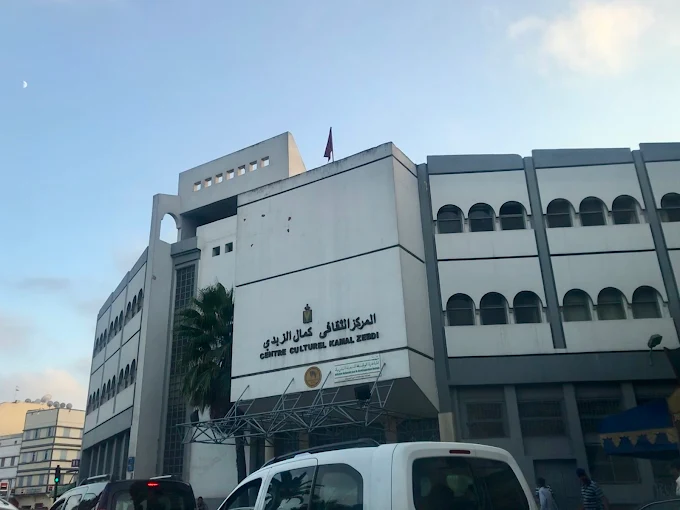
Kamal Zebdi Cultural Complex
Founded in 1986 in Ben M’Sick–Sbata, Kamal Zebdi Cultural Complex is a public neighbourhood venue with a 237-seat theatre, exhibition areas, arts workshops, reading programmes and community activities.
Why visit
About Kamal Zebdi Cultural Complex
A neighbourhood cultural institution in southern Casablanca
Kamal Zebdi Cultural Complex is one of Casablanca’s principal public cultural facilities serving Ben M’Sick and Sbata. Located at the junction of Al Joulane Avenue and Reda Guedira Street, it has spent several decades bringing live performance, visual arts, reading and creative education closer to residents outside the city centre.
Founded in 1986, the complex belongs to the network of cultural establishments supported by the City of Casablanca. Its operation has historically involved cooperation between the municipality and the ministry responsible for culture. Information published by the Ben M’Sick district records a site of approximately 1,600 square metres and, for the documented period, close to 18,000 visitors and participants per year.
These figures should be treated as historical institutional indicators rather than a guaranteed measure of current attendance. They nevertheless show the scale of the venue’s role in a dense urban area where permanent access to artistic infrastructure matters.
A 237-seat theatre
The complex contains a dedicated performance hall used by theatre companies, musicians, dancers and cultural organisations. Its published technical profile lists:
- 237 seats;
- a stage measuring approximately 63 square metres;
- three dressing rooms;
- facilities suited to performance, rehearsal and artistic projects.
This medium-sized auditorium can accommodate professional productions while preserving a direct relationship between performers and audiences. The complex has hosted plays, touring programmes, debates on Moroccan theatre and stages of cultural festivals, including Amazigh theatre initiatives in Casablanca.
Visual arts, exhibitions and first opportunities
Visual art is one of the venue’s enduring activities. Its exhibition spaces have presented both established artists and emerging practitioners, while regular workshops have introduced residents to drawing, painting and visual composition.
In 2014, Azzeddine Hachimi Idrissi presented his exhibition Return to the Sources at the centre, combining abstraction, geometry, spirituality and cultural references. Other artists describe Kamal Zebdi as an early learning environment or a first public exhibition space. The painter Fatima Hassan El Farouj, for example, has recalled taking classes there for three years and producing dozens of paintings before developing her professional career.
This educational role is essential. The complex does not only display completed work; it helps residents learn how to observe, draw, paint, create and present their own work.
Creative learning throughout the year
Activities change according to the season, available staff and partnerships, but usually include:
- drawing and visual arts;
- music and artistic initiation;
- theatre and stage expression;
- reading, writing and literary encounters;
- programmes for children and teenagers;
- training, conferences and community-led activities.
The continuity of these programmes distinguishes a neighbourhood cultural centre from a venue used only for occasional events. A single exhibition can attract attention; a workshop followed over several months builds skill, confidence and a lasting relationship with artistic practice.
In October 2025, the complex was still hosting a workshop on children’s literature and creative writing in partnership with the Moroccan Pen Club, demonstrating the continuing importance of young audiences, reading and imagination.
A home for associations and public discussion
Kamal Zebdi also provides working space for associations, collectives, researchers and civic initiatives from Ben M’Sick–Sbata. Cultural conferences, educational meetings, public debates, prize ceremonies and training activities have all taken place there.
This role is linked both to the building’s flexibility and to its position within the city. In neighbourhoods where affordable spaces for meeting, rehearsing and exhibiting are scarce, the complex offers essential infrastructure to organisations without their own premises.
Its cultural value should therefore not be judged only through headline performances. A children’s workshop, a school exhibition, an association meeting or a theatre rehearsal can be equally important to local cultural life.
Culture beyond central Casablanca
Casablanca has museums, commercial galleries, foreign cultural institutes and major performance halls, but this offer remains unevenly distributed. Kamal Zebdi belongs to a different cultural geography: permanent public facilities located within large residential districts.
It complements other neighbourhood institutions such as the Mohamed Zefzaf Cultural Complex, the Al Hassani Cultural Complex, the Sidi Belyout Cultural Complex and Les Étoiles de Sidi Moumen.
The venue shows that cultural access depends not only on festivals or landmark buildings. It also requires permanent local spaces, staff, workshops and stages that residents can use throughout the year.
The name Kamal Zebdi
The complex is named after Kamal Zebdi, described by several cultural resources as a Moroccan figure associated with painting, poetry and artistic life. However, detailed biographical information available online is not yet supported by sufficient institutional archives or authoritative publications.
For that reason, this guide does not repeat uncertain dates or biographical claims as established fact. The name nevertheless remains a central part of the institution’s identity and its connection to Moroccan artistic memory.
An active venue
Programmes documented in 2025 and July 2026 show that the complex remains in use. In July 2026, artists, arts teachers and cultural officials met there to discuss the next phase of collective work and artistic education.
Published opening hours are inconsistent. Some directories list daytime opening from Monday to Saturday, while others show longer weekday hours.
The complex should not be understood as a commercial cinema with daily screenings. Film or video may form part of particular cultural programmes, but no verified regular cinema operation has been identified.
Planning a visit
Address: junction of Al Joulane Avenue and Reda Guedira Street, Ben M’Sick–Sbata, Casablanca 20450, Morocco
Telephone: +212 5 22 37 21 89
Main auditorium: 237-seat theatre
Access: free, registration-based, invitation-only or ticketed depending on the organiser and event
Chtaiba tram stop on Line T3 is located nearby, and several bus routes serve Al Joulane Avenue and the surrounding districts.
Confirm access conditions directly with the venue or organiser. Continue with Casablanca’s cultural places and current events in the city.
Explore by type
More cultural centres & institutes in Casablanca
Continue with other published English venue profiles in the same city.
Keep exploring
Cultural places near Kamal Zebdi Cultural Complex
Distances below are approximate straight-line distances based on verified coordinates.

Les Étoiles de Sidi Moumen Cultural Centre
The founding centre of Morocco’s Les Étoiles network, this Ali Zaoua Foundation venue uses arts, languages,…
Approx. 4.6 km away
Instituto Cervantes Morocco – Casablanca
Spain’s cultural network in Morocco, with Spanish courses, exams, libraries, film, literature, exhibitions…
Approx. 4.9 km awayLocation
Find Kamal Zebdi Cultural Complex
Continue exploring
Build a cultural day in Casablanca
Connect this venue with current events, heritage, neighbourhoods and other cultural places in Culturama’s Casablanca guide.